Humana health insurance medicare supplement plans are one of the most practical ways seniors can plug the coverage gaps that Original Medicare leaves behind. From hospital coinsurance to skilled nursing facility costs, these Medigap plans work as a financial backstop that keeps out-of-pocket expenses predictable — which matters a lot when you’re living on a fixed income.
Humana has been a major player in the Medicare space for decades, offering standardized Medigap plans like Plan G and Plan N across most states. What sets the decision apart isn’t the benefits themselves — those are federally standardized — it’s the premium pricing, customer service track record, and the extra perks Humana bundles in.
Understanding how these plans are structured, what they cost, and how they stack up against competitors like AARP/UnitedHealthcare and Mutual of Omaha gives you a real edge when it’s time to enroll.
Overview of Humana Health Insurance Medicare Supplement Plans
Did you know that Original Medicare only covers about 80% of your medical costs? That remaining 20% can add up to thousands of dollars out of your own pocket — and that’s exactly where Humana Medicare Supplement plans step in.
Humana Medicare Supplement plans, also called Medigap plans, work alongside Original Medicare (Part A and Part B) to cover the gaps that Medicare leaves behind. We’re talking about copayments, coinsurance, and deductibles that would otherwise drain your savings. You pay a monthly premium to Humana, and in return, they pick up those leftover costs so you’re not hit with surprise medical bills.
Humana’s Role as a Medicare Supplement Powerhouse
Humana isn’t a newcomer here. Founded in 1961, Humana has grown into one of the largest health insurance companies in the United States, consistently ranking among the top Medicare insurers by enrollment. They serve millions of Medicare beneficiaries across the country and have decades of experience navigating the complexities of federal health coverage.
BUT here’s what really sets Humana apart: their nationwide footprint combined with a reputation for strong customer service and plan flexibility. I’ve seen many insurers come and go in this space, and Humana’s longevity speaks volumes about their reliability in the Medicare market.
Who Qualifies to Enroll in Humana Medicare Supplement Plans
To enroll in a Humana Medigap plan, you must first be enrolled in both Medicare Part A and Part B. Most beneficiaries become eligible at age 65. Here’s the deal — your best window to enroll is during your 6-month Medigap Open Enrollment Period, which starts the month you turn 65 and are enrolled in Part B.
During this window, Humana cannot deny you coverage or charge you more based on health conditions.
Some states also allow under-65 beneficiaries with qualifying disabilities to enroll, though availability varies. Missing your Open Enrollment Period means you could face medical underwriting, which may result in higher premiums or denial of coverage.
Pro Tip:Always apply for your Humana Medicare Supplement plan during your Open Enrollment Period. It’s the single most powerful move you can make to lock in the best rate without health questions.
Humana Medicare Supplement Plan Types at a Glance
Humana offers several standardized Medigap plan types, each with different levels of coverage. Here’s a quick breakdown to help you compare your options:
| Plan Type | Coverage Highlights | Est. Monthly Premium | State Availability |
|---|---|---|---|
| Plan A | Basic benefits, Part A coinsurance | $80 – $150 | Most states |
| Plan B | Plan A benefits + Part A deductible | $100 – $180 | Most states |
| Plan G | Comprehensive coverage except Part B deductible | $120 – $250 | Widely available |
| Plan N | Lower premiums, small copays for office visits | $90 – $200 | Most states |
| High-Deductible Plan G | Plan G benefits after high deductible met | $30 – $80 | Select states |
Coverage Benefits Included in Humana Medicare Supplement Plans
Did you know a single hospital stay can cost seniors over $20,000 out-of-pocket without proper coverage? That’s exactly the gap Humana Medicare Supplement plans are designed to close.
Original Medicare leaves you exposed to coinsurance, copays, and deductibles that add up fast. Humana Medigap plans step in to cover those leftover costs — giving you predictable expenses instead of financial surprises. For seniors on fixed incomes, that predictability is everything.
Core Benefits That Directly Reduce Your Out-of-Pocket Risk
Here is the deal: not all Medicare gaps are equal. Some hit harder than others. Humana Medigap plans target the most damaging ones first.
The Medicare Part A hospital coinsuranceis one of the biggest exposures — up to $800+ per day after day 60 in the hospital. Humana covers that entirely under most plans. You also get skilled nursing facility coinsurance coverage, which kicks in after day 20 and can run $200+ per day without a supplement.
AND if you travel internationally, select Humana plans include foreign travel emergency coverageup to plan limits — something original Medicare doesn’t touch at all.
Plan G vs. Plan N: A Side-by-Side Coverage Breakdown
Choosing between Plan G and Plan N is one of the most common decisions Humana enrollees face. Here’s exactly how they stack up:
| Benefit Category | Plan G Coverage | Plan N Coverage | Member Cost Responsibility |
|---|---|---|---|
| Part A Hospital Coinsurance | 100% covered | 100% covered | None (both plans) |
| Part B Coinsurance/Copay | 100% covered | Covered (with copays) | Up to $20 office / $50 ER (Plan N) |
| Part B Excess Charges | 100% covered | Not covered | Full excess charge (Plan N) |
| Part A Deductible | 100% covered | 100% covered | None (both plans) |
| Foreign Travel Emergency | 80% after deductible | 80% after deductible | 20% + $250 deductible (both plans) |
| Skilled Nursing Coinsurance | 100% covered | 100% covered | None (both plans) |
Plan G gives you more complete coveragewith fewer surprises. Plan N trades some coverage for a lower monthly premium — a smart tradeoff if you rarely visit specialists or non-participating providers.
Wellness Perks and Added Benefits Bundled With Select Plans
BUT coverage isn’t the only thing Humana brings to the table. Depending on your plan and location, Humana may bundle in benefits that go beyond standard Medigap requirements.
These extras can include access to SilverSneakers fitness programs, which give you free gym memberships at thousands of locations nationwide. Some enrollees also get telehealth accessfor virtual doctor visits — a huge convenience for seniors with mobility challenges. Humana has also offered nurse hotline servicesand health coaching tools through select supplement products.
- SilverSneakers or comparable fitness program access
- 24/7 nurse advice lines for non-emergency health questions
- Telehealth services for virtual primary care visits
- Health and wellness discounts through Humana’s partner network
Pro Tip:Always call Humana directly or check your specific plan documents to confirm which wellness perks are available in your ZIP code — availability varies by state and plan year.
Humana Medicare Supplement Plan Costs and Pricing Factors
Did you know two people enrolling in the exact same Humana Medicare Supplement plancan pay wildly different premiums — sometimes hundreds of dollars apart every month? Your premium isn’t random. It’s calculated using a specific set of factors that you need to understand before you sign up.
Here’s the deal: Humana uses several variables to determine what you’ll pay monthly. These include your age, gender, ZIP code, tobacco use, and — most importantly — the premium rating methodapplied in your state. Getting this wrong can cost you thousands over a decade.
The Three Rating Methods That Determine Your Long-Term Premium, Humana health insurance medicare supplement
This is where most people get blindsided. The rating method Humana uses in your state directly controls how your premium grows over time. There are three types, and they are NOT equal.
- Community-rated:Everyone in your area pays the same premium regardless of age. Your rate only increases due to inflation — not because you’re getting older. This is the most predictable long-term option.
- Issue-age-rated:Your premium is locked based on the age you enroll. Enroll at 65 and you lock in a lower base rate. BUT it still rises with inflation over time.
- Attained-age-rated:Your premium increases as you age. It starts low — which looks attractive — but compounds significantly by your 70s and 80s. This is the most common method and the one that catches people off guard.
Most states allow attained-age rating, which means your Humana premium at 80 could be 50–100% higherthan what you paid at 65 for the same plan.
Sample Monthly Premium Ranges by Age, Plan, and Tobacco Status
Below are estimated monthly premium ranges based on publicly available Humana rate data. These are illustrative samples — your actual quote depends on your specific ZIP code and plan availability.
| Age Group | Plan Type | State Example | Non-Tobacco / Tobacco Rate |
|---|---|---|---|
| Age 65 | Plan G | Florida | $110–$140 / $130–$170 |
| Age 70 | Plan G | Texas | $145–$185 / $175–$220 |
| Age 75 | Plan N | Ohio | $160–$210 / $195–$255 |
| Age 80+ | Plan N | Georgia | $210–$280 / $255–$340 |
Out-of-Pocket Costs You Still Owe After Enrolling
A Humana Medigap plan covers a lot — but it doesn’t cover everything. You need to know exactly what’s still coming out of your wallet.
- Part B deductible:Plan G enrollees still pay the annual Medicare Part B deductible ($240 in 2024). Only Plan F covers this — but F is no longer available to new Medicare enrollees.
- Plan N copays:With Plan N, you pay up to $20 per office visitand up to $50 for emergency room visits that don’t result in inpatient admission.
- Part B excess charges:Plan N does NOT cover excess charges. If your doctor doesn’t accept Medicare assignment, you could owe up to 15% above the Medicare-approved amount.
- Prescription drugs:No Humana Medigap plan covers Part D drugs. You need a separate Part D planfor medication coverage.
- Dental, vision, hearing:These are excluded from all standardized Medigap plans entirely.
Pro Tip:If you’re choosing between Plan G and Plan N, run the math on your typical annual doctor visits. Plan N’s lower premium can save you money — but only if your copay total stays below the premium difference. For most healthy enrollees at 65, Plan N wins on cost.
How to Enroll in a Humana Medicare Supplement Plan
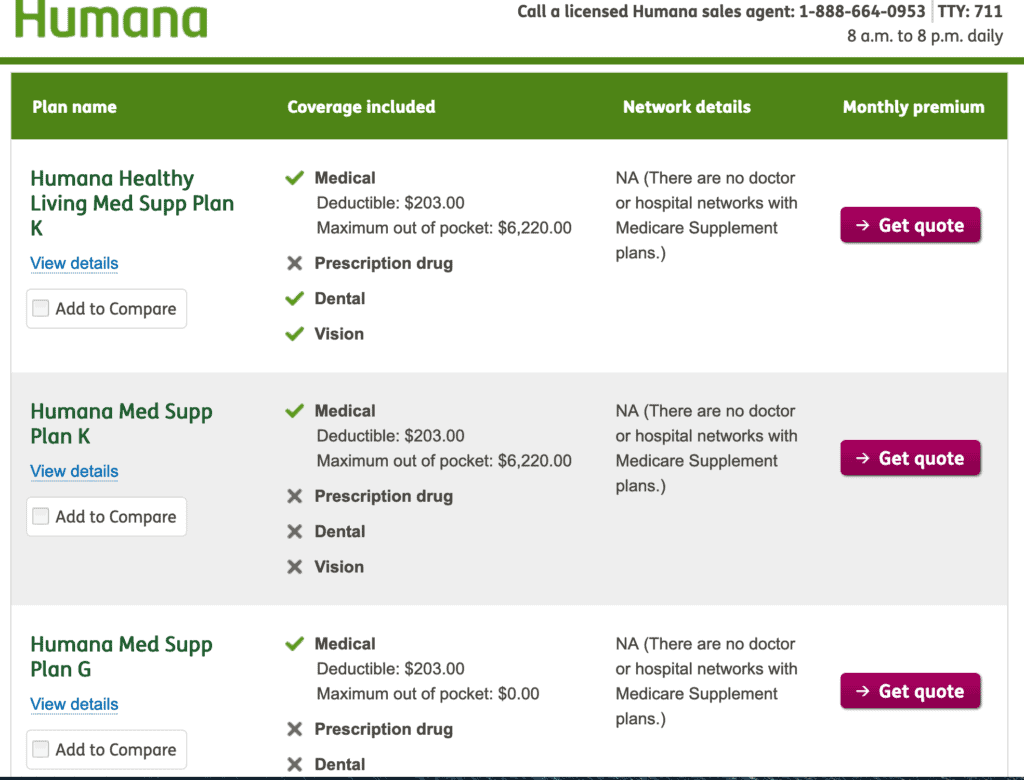
Most people miss their best shot at affordable Medigap coverage simply because they didn’t know the enrollment window existed. Here’s exactly how to get it right with Humana.
Enrolling in a Humana Medicare Supplement plan isn’t complicated — BUT timing is everything. Miss the right window and you could face higher premiums or outright denial based on your health history. Follow these steps and you’ll lock in coverage without the headaches.
Step-by-Step Enrollment Process for Humana Medigap
Before anything else, you need to confirm you’re already enrolled in Medicare Part A and Part B. Humana Medicare Supplement plans are built on top of Original Medicare, so both parts are non-negotiable prerequisites.
- Verify your Medicare Part A and Part B enrollment through your Medicare card or SSA.gov account.
- Compare available Humana Medigap plan types (Plan G, Plan N, etc.) in your ZIP code using Humana’s online plan finder or by calling 1-800-HUMANA.
- Gather your Medicare Beneficiary Identifier (MBI) number — you’ll need it on the application.
- Complete Humana’s application online, by phone, or through a licensed insurance agent.
- Review your approval notice and confirm your coverage start dateto avoid any gap between your current coverage and your new plan.
Why the Medigap Open Enrollment Period Is Your Golden Ticket
Here’s the deal: the Medigap Open Enrollment Period (OEP)is a six-month window that starts the month you turn 65 AND are enrolled in Medicare Part B. During this window, Humana — like all insurers — must accept your application regardless of pre-existing conditions.
That means no medical underwriting, no health questionnaires that can disqualify you, and no inflated premiums based on your health status. This is the single most powerful enrollment protection available to Medicare beneficiaries, and most people only get one shot at it.
Pro Tip:Mark your Part B enrollment date on your calendar immediately. Your OEP countdown starts that day — not your birthday. If you delay enrolling in Part B, you delay your OEP, and that mistake can cost you hundreds of dollars per year in higher premiums for life.
Also, apply with Humana at least 30 days before your desired start date to avoid any coverage gaps.
Special Enrollment Periods That Open the Door Outside the Standard Window
Missed your OEP? You’re not necessarily out of options. Certain life events trigger a Guaranteed Issue Right, which forces Humana to accept your application without health screening — even outside the standard window.
These Special Enrollment Periods (SEPs) apply in specific situations. Here’s when you qualify:
- Your current Medicare Advantage plan is leaving your service area or discontinuing coverage.
- You’re moving out of your Medicare Advantage plan’s coverage area permanently.
- Your employer-sponsored retiree coverage is ending involuntarily.
- You enrolled in a Medicare Advantage plan when you first became eligible but want to switch back to Original Medicare with a Medigap supplement.
- A Humana Medigap plan you previously held was discontinued by the insurer.
Outside of these SEPs, Humana can apply medical underwritingin most states, meaning your health history directly impacts whether you’re approved and what you’ll pay. Some states like New York and Connecticut have continuous open enrollment protections — check your state’s rules before assuming you’re locked out.
Enrollment Deadlines and Coverage Gap Prevention
The biggest mistake I see people make is waiting until the last minute and ending up with a gap between their old coverage and their new Humana plan. A single uncovered month can mean thousands of dollars in out-of-pocket costs if something goes wrong.
Use this quick reference to stay on track:
| Enrollment Trigger | Window Duration | Guaranteed Issue? |
|---|---|---|
| Medigap Open Enrollment Period | 6 months from Part B start | Yes |
| Medicare Advantage plan ending | 63 days from loss of coverage | Yes |
| Involuntary loss of retiree coverage | 63 days from loss of coverage | Yes |
| Outside any qualifying period | Anytime (underwriting applies) | No |
Comparing Humana Medicare Supplement to Other Insurers

Did you know that over 14 million Americanshold a Medigap policy — yet most never compare more than one insurer before signing up? That’s a costly mistake.
Here’s the deal: all Medicare Supplement plans are federally standardized. A Plan G from Humana covers the exact same benefits as a Plan G from AARP/UnitedHealthcare or Mutual of Omaha. BUT the premium you pay and the experience you get can vary dramatically.
That’s why comparing insurers head-to-head is the smartest move you can make.
Side-by-Side Insurer Comparison: Humana vs. The Competition
Use this table to see how Humana stacks up against two of the biggest names in the Medigap market:
| Insurer | Available Plan Types | Average Monthly Premium (Plan G) | Notable Features |
|---|---|---|---|
| Humana | A, B, C, D, F, G, K, L, N | $120–$180 | Dental/vision add-ons, SilverSneakers fitness, strong financial ratings |
| AARP/UnitedHealthcare | A, B, C, F, G, K, L, N | $130–$200 | Largest Medigap network, household discounts, 24/7 nurse line |
| Mutual of Omaha | A, D, F, G, N | $115–$175 | Competitive pricing, high customer satisfaction, stable rate history |
Where Humana Wins — And Where It Falls Short
I’ll be straight with you. Humana has real strengths that competitors can’t easily match. Their bundled wellness perks like SilverSneakers and optional dental/vision riders add genuine value beyond raw coverage. Humana also holds strong financial stability ratings from AM Best, which matters when you’re locking in a long-term policy.
BUT Humana isn’t perfect. AARP/UnitedHealthcare has a larger brand footprint and more aggressive household discounts. Mutual of Omaha often edges out Humana on pure price in certain states. Network flexibility is a non-issuewith any Medigap plan since you can see any Medicare-accepting doctor nationwide — so don’t let that be a deciding factor.
Why Standardization Makes Price and Reputation Everything
This is the part most people miss. Because the federal government standardizes Medigap benefits, the only real differentiators are premium cost, company reputation, and customer service. You’re not getting “better coverage” by paying more — you’re paying for brand trust and service quality.
Humana consistently scores well in J.D. Power customer satisfaction studies. But I always tell people: get quotes from at least three insurers in your ZIP code before deciding. Premiums vary by location, age, and gender more than most seniors realize.
Criteria to Decide If Humana Is Right for You
Before you commit, run through this checklist:
- Budget fit:Get a personalized Humana quote and compare it against Mutual of Omaha and one regional insurer in your state.
- Wellness priorities:If SilverSneakers or dental add-ons matter to you, Humana has a clear edge.
- Rate stability history:Ask your agent how much Humana has raised premiums in your state over the past five years.
- Customer service access:Check Humana’s NAIC complaint index for your state — lower is better.
- Financial strength:Confirm the insurer holds at least an A- rating from AM Best before signing anything.
Pro Tip:Use Medicare’s official Plan Finder tool alongside a licensed independent broker. Brokers who work with multiple carriers will show you Humana’s real-world pricing versus competitors — without the sales bias of a captive agent.
Visual and Descriptive Guide to Understanding Humana Medicare Supplement
Most people have no idea how their Medicare claims actually get paid — and that confusion costs them thousands of dollars every year. Let me break it down visually so it finally clicks.
Think of your coverage as a two-layer payment system. Original Medicare moves first, then Humana steps in to cover what’s left. Once you see the flow, the whole thing makes sense instantly.
How a Medical Claim Flows Through the Two-Layer Payment System
Here’s the deal — when you visit a doctor, your claim doesn’t go to Humana first. It goes to Original Medicare. Picture it as a waterfall with two tiers.
- Step #1 — Medicare Part A or Part B processes the claimand pays its approved share (typically 80% for Part B services after your deductible).
- Step #2 — The remaining 20% balancegets forwarded automatically to Humana’s Medigap plan.
- Step #3 — Humana pays its portionbased on your specific plan letter (Plan G, Plan N, etc.), often covering that remaining balance entirely.
- Step #4 — You receive an Explanation of Benefitsfrom both Medicare and Humana showing exactly what each payer covered.
The result? In many cases, your out-of-pocket cost is literally zero after both layers process the claim.
The Overlapping Coverage Layer Diagram Explained
Imagine three overlapping circles — like a Venn diagram. Medicare Part Acovers the left circle (hospital stays, skilled nursing, hospice). Medicare Part Bcovers the right circle (doctor visits, outpatient care, preventive services). The Humana Supplement plan sits in the middle, overlapping both circles and filling the cost gaps each one leaves behind.
| Coverage Layer | What It Pays | Your Responsibility Without Supplement |
|---|---|---|
| Medicare Part A | Hospital costs after deductible | $1,676 deductible per benefit period (2025) |
| Medicare Part B | 80% of approved outpatient costs | 20% coinsurance — unlimited exposure |
| Humana Medigap (Plan G) | Remaining gaps from both A and B | Only the Part B deductible ($257 in 2025) |
The Typical Humana Medicare Supplement Enrollee Profile
You might be wondering — is this plan actually for someone like me? I can tell you the profile fits a very specific type of person.
- Age range:65–74, newly Medicare-eligible or recently retired
- Health background:One or two manageable chronic conditions (hypertension, diabetes, joint issues) requiring regular specialist visits
- Financial situation:Fixed income from Social Security plus modest retirement savings — predictable monthly costs matter more than low premiums
- Coverage priority:Wants zero surprise bills and freedom to see any Medicare-accepting doctor nationwide without referrals
If that sounds like you, Humana’s Medigap plans are designed almost exactly around your situation. The tradeoff is a higher monthly premium — but the financial predictability is worth it for most enrollees in this profile.
What You Actually See on a Humana Explanation of Benefits Document
After a covered visit, Humana mails or digitally delivers your EOB. It’s not a bill — BUT most people panic when they see it anyway.
The document shows four key columns: the billed amount from your provider, what Medicare approved, what Medicare paid, and what Humana paid. Your personal responsibility appears at the bottom — often showing $0.00 in bold.
Pro Tip:Log into Humana’s MyHumana portal within 48 hours of a visit. You can track your EOB in real time, verify claim status, and catch billing errors before they become collection issues.
The EOB also includes a running tally of your annual deductible progress and any out-of-pocket accumulation— so you always know exactly where you stand financially before your next appointment.
Final Summary: Humana Health Insurance Medicare Supplement
Choosing the right Medicare Supplement plan comes down to three things: coverage fit, cost over time, and the insurer’s reliability. Humana checks those boxes for a lot of seniors, especially those who want the flexibility of any Medicare-accepting provider without referral headaches.
Plan G covers the most ground for new enrollees, while Plan N offers a lower premium trade-off if you’re comfortable with some cost-sharing. Either way, enrolling during your Open Enrollment Period is the smartest move — it locks in your acceptance regardless of health history.
Do the comparison, run the numbers by age and state, and pick the plan that protects your budget without overcomplicating your healthcare.
Frequently Asked Questions
Can I use any doctor with a Humana Medicare Supplement plan?
Yes. Humana Medigap plans work with any doctor or hospital that accepts Original Medicare. There are no network restrictions, so you’re not limited to a specific provider list.
Does Humana Medicare Supplement cover prescription drugs?
No. Medigap plans do not include prescription drug coverage. You would need to enroll in a separate Medicare Part D plan to cover medications.
Can I be denied a Humana Medigap plan due to a pre-existing condition?
Outside of your Open Enrollment Period, Humana can use medical underwriting and may deny coverage or charge higher premiums based on health history. During Open Enrollment, guaranteed issue rights apply and denial is not permitted.
Is there a waiting period before Humana Medigap coverage kicks in?
Generally no, if you enroll during your Open Enrollment Period. However, if you enroll outside that window and have a pre-existing condition, some plans may impose a waiting period of up to six months for those specific conditions.
How does Humana’s Medigap pricing change as I get older?
It depends on the rating method used in your state. Attained-age-rated plans increase premiums as you age, which is the most common method. Issue-age-rated plans lock your rate based on when you first enrolled, and community-rated plans charge everyone the same regardless of age.
Can I switch from a Humana Medicare Advantage plan to a Humana Medigap plan?
Yes, but timing matters. You typically need to be within a valid enrollment or trial period. Switching outside those windows may require medical underwriting, and approval is not guaranteed depending on your state and health status.
