How much is auto insurance in Massachusetts is one of the most searched questions by drivers in the Bay State — and for good reason. Massachusetts consistently ranks among the more expensive states for car insurance, with average annual premiums sitting well above the national average.
Whether you’re a new driver, a Boston commuter, or someone looking to cut costs, understanding what you’re actually paying for matters.

The price you pay depends on a web of factors: your age, driving record, the city you live in, the car you drive, and even your credit score. A teen driver in Springfield pays a wildly different rate than a 40-year-old with a clean record in Cape Cod.
On top of that, Massachusetts operates under a no-fault insurance system, which shapes both your coverage requirements and your out-of-pocket costs after an accident. Knowing how these pieces fit together gives you real leverage when shopping for a policy.
Average Cost of Auto Insurance in Massachusetts
Here’s a number that might surprise you: the average Massachusetts driver pays $1,986 per yearfor auto insurance in 2025. That’s nearly 15% above the national average — and most people have no idea why.
I’ve dug into the latest data so you can see exactly what you’re paying for, whether you’re carrying minimum liability or full coverage. The breakdown below shows what drivers across the state are actually spending right now.
Massachusetts Auto Insurance Premiums by Coverage Level (2025)
The type of coverage you carry makes a massive difference in your premium. Here’s the full breakdown:
| Coverage Type | Average Annual Cost | Average Monthly Cost | Coverage Details |
|---|---|---|---|
| Minimum Liability | $742 | $62 | State-required minimums only: 20/40/5 bodily injury and property damage |
| Standard Liability | $1,104 | $92 | Higher liability limits, no collision or comprehensive |
| Full Coverage | $1,986 | $166 | Liability + collision + comprehensive; most common choice |
| Full Coverage + Extras | $2,410 | $201 | Adds roadside assistance, rental reimbursement, gap coverage |
BUT here’s the deal — most drivers default to full coverage without comparing what they actually need. Minimum liability is dramatically cheaper, but it leaves you exposed if you cause a serious accident.
Pro Tip:If your car is worth less than $4,000, dropping collision coverage could save you $400–$600 per year. Run the math before you auto-renew.
Massachusetts vs. National Average and Neighboring States
How does Massachusetts stack up against the rest of the country — and the states right next door? The comparison is eye-opening:
| State | Average Annual Premium | Average Monthly Premium | Rank Among US States |
|---|---|---|---|
| Massachusetts | $1,986 | $166 | #14 most expensive |
| National Average | $1,730 | $144 | — |
| Connecticut | $2,178 | $182 | #9 most expensive |
| Rhode Island | $2,311 | $193 | #6 most expensive |
| New Hampshire | $1,194 | $100 | #44 most expensive |
You’ll notice something interesting here. Rhode Island and Connecticut are actually more expensivethan Massachusetts — but New Hampshire is dramatically cheaper. That gap isn’t random.
Why Massachusetts Rates Differ From Neighboring States
New Hampshire has no mandatory auto insurance requirement. That changes everything about how risk is priced in that market.
Massachusetts, on the other hand, operates under a managed competition system— the state regulates how insurers can price policies, which limits extreme discounts but also prevents price gouging. Here’s what else drives the difference:
- Population density:Greater Boston is one of the most congested metro areas in the US, which directly raises accident frequency and claim costs.
- No-fault insurance rules:Massachusetts is a no-fault state, meaning your insurer pays your medical bills regardless of who caused the crash — that raises baseline premiums for everyone.
- High vehicle repair costs:Labor rates at Massachusetts auto shops rank among the highest in the Northeast.
- Weather exposure:Harsh winters increase comprehensive claims from ice damage, flooding, and collisions on slick roads.
- Uninsured driver rates:Rhode Island has a higher uninsured motorist rate than Massachusetts, which partly explains its even higher premiums.
The bottom line: where you live within Massachusetts matters almost as much as the state itself.A driver in rural Western Mass pays far less than someone in downtown Boston or Worcester.
Factors That Affect Auto Insurance Rates in Massachusetts
Did you know two drivers in Massachusetts with identical cars can pay hundreds of dollars apart in annual premiums? Your rate isn’t random — it’s built from a specific set of variables that insurers weigh every single time.
Understanding these factors gives you real leverage. I’ve broken down the biggest ones below so you know exactly where your money is going — and where you can fight back.
The Core Rating Factors Massachusetts Insurers Use
Here is the deal: insurers in Massachusetts use a combination of personal, vehicle, and location data to calculate your premium. Your driving history carries the most weight, but it’s far from the only thing on the table.
| Factor | Impact Level | Description | Tips to Improve |
|---|---|---|---|
| Driving History | Very High | Accidents, violations, and at-fault claims directly spike your rate | Keep a clean record for 3+ years to qualify for safe driver discounts |
| Age & Experience | High | Young and inexperienced drivers pay significantly more | Complete a defensive driving course to offset inexperience surcharges |
| Vehicle Type | High | Luxury, sports, and high-theft vehicles cost more to insure | Choose vehicles with strong safety ratings and low theft rates |
| Credit Score | Moderate | Massachusetts limits but does not ban credit-based pricing | Pay down debt and dispute errors on your credit report |
| Location (ZIP Code) | High | Urban areas with dense traffic and theft drive rates up | Garage parking and anti-theft devices can offset location risk |
How Massachusetts No-Fault Laws Shape What You Actually Pay
Massachusetts is a no-fault insurance state— and that single fact changes everything about your coverage costs. Under no-fault rules, your own insurer pays your medical bills after an accident regardless of who caused it, up to your Personal Injury Protection (PIP) limit of $8,000.
BUT here’s the catch. Because insurers are on the hook for more claims automatically, PIP coverage adds a mandatory cost layerto every Massachusetts policy. You can’t opt out. This is a direct reason why base premiums in Massachusetts run higher than in many at-fault states.
Pro Tip:Choosing a higher PIP deductible (up to $8,000 if you have qualifying health insurance) can meaningfully reduce your premium. Talk to your insurer about this option before your next renewal.
How Your ZIP Code Inside Massachusetts Moves the Needle
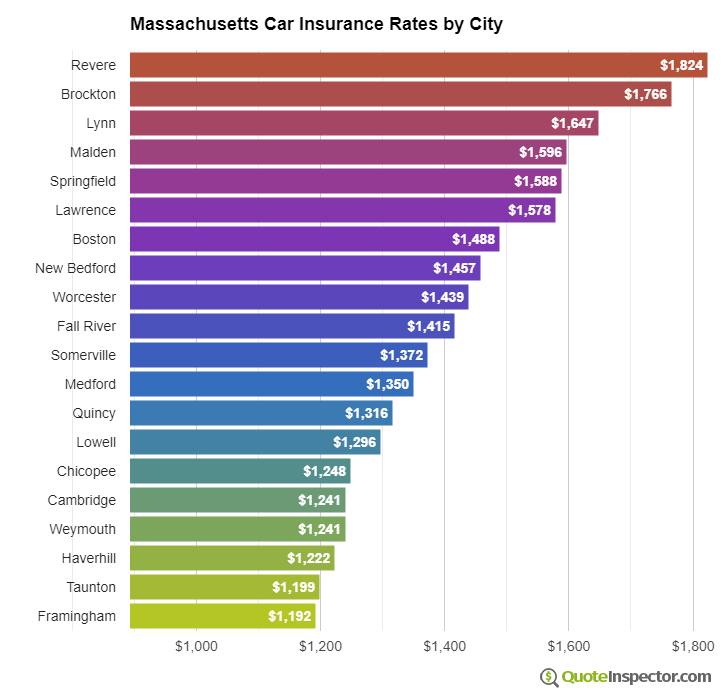
Location isn’t just a minor footnote — it can swing your annual premium by $500 or more. Here’s how major Massachusetts areas stack up:
- Boston:The highest rates in the state. Dense traffic, high accident frequency, and elevated vehicle theft in neighborhoods like Roxbury and Dorchester push premiums well above the state average.
- Worcester:Rates are elevated but more moderate than Boston. Urban congestion and uninsured driver rates in the city center are the main cost drivers.
- Springfield:One of the more expensive mid-size cities in Massachusetts. High uninsured motorist ratesand above-average accident claims make this market costly for insurers — and for you.
- Cape Cod:Rates here tend to be lower than urban centers. Lower population density, less congestion, and fewer theft incidents translate directly into cheaper premiums for residents.
The pattern is clear: the more urban your ZIP code, the more you pay. If you live near a city boundary, it’s worth checking whether a nearby ZIP code carries a meaningfully lower rate with your insurer.
Minimum Required Auto Insurance Coverage in Massachusetts
Did you know Massachusetts is one of only a handful of states that requires Personal Injury Protection (PIP) as mandatory coverage? Most drivers don’t realize how specific the Bay State’s requirements actually are — and that ignorance can cost you big.
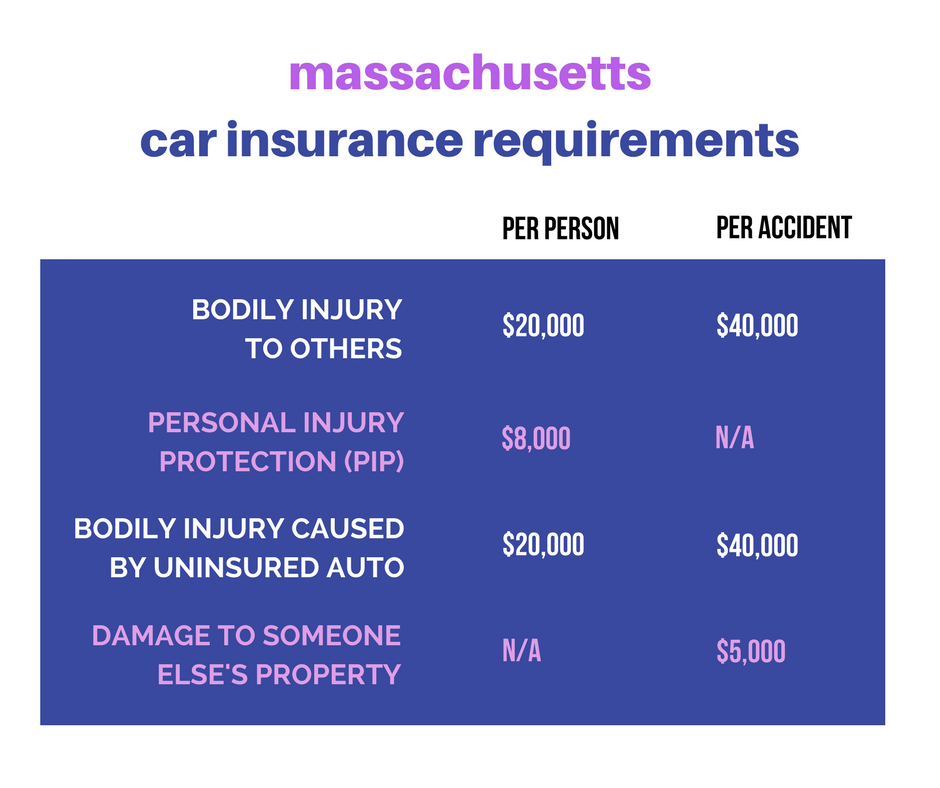
Massachusetts law requires every driver to carry four types of coverage before they can legally hit the road. These aren’t suggestions. They’re hard minimums set by the state, and skipping any one of them puts your license, your wallet, and your freedom at risk.
Massachusetts State Minimum Coverage Requirements Breakdown
Here’s exactly what the state mandates. I’ve broken it down so you can see what you’re actually paying for:
| Coverage Type | Minimum Required Limit | What It Covers | Estimated Cost Range |
|---|---|---|---|
| Personal Injury Protection (PIP) | $8,000 per person | Medical bills and lost wages regardless of fault | $80–$150/year |
| Bodily Injury Liability | $20,000 per person / $40,000 per accident | Injuries you cause to others | $150–$300/year |
| Property Damage Liability | $5,000 per accident | Damage you cause to other vehicles or property | $50–$120/year |
| Uninsured Motorist Coverage | $20,000 per person / $40,000 per accident | Protects you if hit by an uninsured driver | $40–$100/year |
Legal Penalties for Driving Uninsured in Massachusetts
HERE’S THE DEAL: Massachusetts takes uninsured driving seriously. Getting caught without coverage can result in fines up to $5,000, a one-year license suspension, and even up to one year in jail.Your vehicle registration gets revoked too. That’s not a slap on the wrist — that’s a life disruption.
On top of state penalties, you’re personally liable for every dollar of damage or injury you cause. One bad accident without insurance can financially wipe you out for years.
Pro Tip:Even if you’re between cars or rarely drive, a non-owner auto insurance policy in Massachusetts keeps you legally covered and costs as little as $200–$400 per year. Way cheaper than a $5,000 fine.
Minimum Coverage vs. Full Coverage: What You Actually Get
BUT here’s where most drivers get confused. Minimum coverage keeps you legal. Full coverage actually protects your finances.The difference in cost is smaller than you think:
| Coverage Level | Average Annual Cost | What’s Included | Recommended Driver Profile |
|---|---|---|---|
| State Minimum | ~$620/year | PIP, bodily injury, property damage, uninsured motorist | Drivers with older vehicles worth under $4,000 |
| Full Coverage | ~$1,480/year | Everything above + collision + comprehensive | Drivers with newer or financed vehicles |
| Full Coverage + Extras | ~$1,750–$2,100/year | All above + roadside assistance, rental reimbursement | High-mileage commuters and families |
I always tell people: if your car is worth more than 10x your annual premium, full coverage is almost always worth it.Do the math before you assume minimum coverage is the smart play.
Cheapest Auto Insurance Companies in Massachusetts
Massachusetts drivers pay some of the highest auto insurance rates in the country. BUT finding a cheap policy here is absolutely possible — if you know which companies to target.
I’ve dug into the data, and the difference between the most expensive and cheapest insurer in Massachusetts can be over $800 per yearfor the same coverage. That’s real money. Here’s the deal: not all insurers price Massachusetts risk the same way, so shopping around isn’t optional — it’s essential.
Top Affordable Auto Insurers in Massachusetts: Side-by-Side Breakdown
Below is a comparison of the most competitive auto insurance companies available to Massachusetts drivers right now. These figures reflect average annual premiums for a full-coverage policy on a standard driver profile.
| Insurance Company | Avg. Annual Premium | Available Discounts | Customer Satisfaction |
|---|---|---|---|
| Geico | ~$1,050 | Good driver, multi-policy, military | 4.2 / 5 |
| Progressive | ~$1,120 | Snapshot telematics, multi-car, homeowner | 4.0 / 5 |
| Safety Insurance | ~$1,175 | Multi-policy, good student, low mileage | 4.3 / 5 |
| Mapfre | ~$1,210 | Safe driver, multi-car, paperless billing | 4.1 / 5 |
| Arbella | ~$1,260 | Multi-policy, accident forgiveness, loyalty | 4.4 / 5 |
Discounts Massachusetts Drivers Are Leaving on the Table
Here’s the deal: most drivers qualify for at least three discounts but only claim one. These are the most common ones — and what they’re actually worth.
- Good Driver Discount:No accidents or violations in 3+ years. Saves you roughly $150–$250/yeardepending on the insurer.
- Multi-Policy (Bundling) Discount:Combine auto with home or renters insurance. Typical savings hit $100–$200/year.
- Good Student Discount:Full-time students with a B average or better. Can knock off $75–$150/yearfrom your premium.
- Low-Mileage Discount:Drive under 7,500 miles annually. You could save $80–$180/year— especially relevant for remote workers.
- Telematics/Usage-Based Discount:Programs like Progressive’s Snapshot track your driving habits. Safe drivers save up to $200/year.
Pro Tip:Safety Insurance and Arbella are Massachusetts-based carriers. They understand local roads, local claims, and local risk — which often translates to better customer service and faster claims processing compared to national giants.
How Age and Driving Experience Impact Rates in Massachusetts
Did you know a 17-year-old in Massachusetts can pay over $7,000 per yearfor auto insurance? That’s not a typo. Age is one of the single biggest pricing levers insurers use — and understanding it can save you thousands.
Insurance companies price risk. And statistically, younger drivers crash more often. BUT here’s the deal: rates don’t stay high forever. As you build a clean driving record, premiums drop significantly — sometimes by 50% or more between your teen years and your late 20s.
Massachusetts Auto Insurance Rates by Age Group, How much is auto insurance in massachusetts
Here’s a breakdown of what drivers typically pay across different life stages in Massachusetts:
| Age Group | Avg. Annual Premium | Risk Profile | Money-Saving Tips |
|---|---|---|---|
| Teen (16–19) | $5,500–$7,200 | Highest risk | Good student discount, stay on parent’s policy |
| Young Adult (20–25) | $2,800–$4,500 | High risk | Telematics programs, defensive driving course |
| Adult (26–55) | $1,200–$1,900 | Low-moderate risk | Bundle policies, loyalty discounts |
| Senior (65+) | $1,500–$2,400 | Moderate-high risk | Mature driver course, low-mileage discount |
Your First Five Years Behind the Wheel: What to Expect
If you’re a first-time driver in Massachusetts, here’s the honest truth: your first year will be expensive. But the trajectory improves fast if you stay clean. Here’s what the typical rate journey looks like:
- Year 1:Expect peak premiums. No driving history means maximum risk in the insurer’s eyes.
- Year 2:A clean record starts to matter. Some insurers drop rates by 10–15% automatically.
- Year 3:You may qualify for your first safe driver discount— typically 5–20% off.
- Year 4–5:Rates can drop 30–40% from your starting point if you’ve had zero claims or violations.
Pro Tip:Enroll in a telematics program like Progressive’s Snapshot or Allstate’s Drivewise during your first year. Even with zero history, proving you’re a safe driver in real-time can unlock discounts of up to 30% — faster than waiting for time to do the work.
Programs Built for Young and New Drivers in Massachusetts
Massachusetts has several driver-friendly programsthat can meaningfully cut costs for newer drivers. You just have to know where to look.
- Good Student Discount:Most major insurers offer 8–25% off for full-time students maintaining a B average or higher. Keep those grades up — it literally pays.
- Telematics/Usage-Based Insurance:Programs like Liberty Mutual’s RightTrack track your actual driving behavior. Safe habits = real savings, regardless of your age.
- Defensive Driving Courses:Completing a state-approved course can earn you a discount AND may satisfy court requirements if you’ve had a minor violation.
- Staying on a Parent’s Policy:If you’re under 25 and living at home, staying on your parent’s policyis almost always cheaper than getting your own — sometimes by $1,500+ annually.
Ways to Lower Auto Insurance Costs in Massachusetts: How Much Is Auto Insurance In Massachusetts
Did you know the average Massachusetts driver overpays by hundreds of dollars every year — simply because they never bothered to optimize their policy? Here’s the deal: cutting your premium doesn’t mean cutting your protection.
I’ve broken down the most effective strategies into clear, actionable steps you can use right now. These aren’t vague tips — they’re moves that actually move the needle on your bill.
Step-by-Step Strategies to Cut Your Premium
Follow these steps in order and you’ll be in a much stronger position than most Massachusetts drivers.
- Shop and compare quotes annually.Rates shift constantly. Spending 20 minutes comparing quotes each renewal period can save you $200–$500 per year without changing a single coverage detail.
- Raise your deductible.Bumping your collision deductible from $500 to $1,000 can lower your premium by 10–20%. Just make sure you have that amount sitting in savings first.
- Ask about every discount available.Good driver discounts, low-mileage discounts, multi-car discounts — insurers don’t always volunteer these. You have to ask directly.
- Maintain a clean driving record.A single at-fault accident can spike your rate by 40% or more in Massachusetts. Defensive driving pays off literally.
- Improve your credit score.Massachusetts is one of the states where insurers can use credit history as a rating factor. Even a modest credit improvement can translate to real savings.
- Drop unnecessary coverage on older vehicles.If your car is worth under $4,000, carrying full collision and comprehensive coverage may cost more than the car is worth.
Bundle Your Home and Auto Insurance in Massachusetts
This is one of the fastest wins available to Massachusetts homeowners. Bundling your home and auto policies with the same insurertypically saves between 10% and 25% on your combined premiums.
For example, if you’re paying $1,800/year on auto and $1,200/year on home insurance, a 15% bundle discount saves you $450 annually — just for consolidating. Major carriers like Amica, Liberty Mutual, and Travelers all offer competitive bundle rates in Massachusetts.
| Insurer | Estimated Bundle Discount |
|---|---|
| Amica Mutual | Up to 15% |
| Liberty Mutual | Up to 20% |
| Travelers | Up to 13% |
| Allstate | Up to 25% |
Telematics and Usage-Based Insurance Programs in Massachusetts
Here’s the deal: if you’re a safe driver, telematics programs are basically free money. These programs track your driving behavior — speed, braking, mileage, time of day — through an app or plug-in device.
Drive well and you get rewarded with lower rates. It’s that simple. Several major insurers offer these programs in Massachusetts right now:
- Progressive Snapshot— Drivers save an average of $146/year, with top performers saving up to $231.
- State Farm Drive Safe & Save— Enrollment alone gets you an initial discount, with savings up to 30% based on behavior.
- Allstate Drivewise— Offers cash back rewards plus premium reductions for safe habits.
- Liberty Mutual RightTrack— New customers can save up to 30% after the monitoring period.
Pro Tip:Avoid driving late at night (11pm–4am) during your telematics monitoring period. Insurers flag nighttime driving as high-risk, and it can reduce your discount significantly even if your other habits are perfect.
BUT telematics isn’t for everyone. If you have a long, aggressive commute or frequently drive during peak risk hours, these programs could actually work against you. Opt in only if your driving habits are genuinely low-risk.
Closing Summary
Auto insurance in Massachusetts isn’t cheap, but it’s manageable when you know what drives your rate. From meeting the state’s minimum coverage requirements to comparing quotes across insurers like Geico, Safety Insurance, and Mapfre, every decision you make has a direct impact on your premium.
Stack discounts, consider telematics programs, bundle your policies, and keep your driving record clean — those moves alone can shave hundreds off your annual bill. The drivers who pay the least aren’t just lucky. They’re informed.
FAQ Summary
Is auto insurance more expensive in Massachusetts than in other New England states?
Yes. Massachusetts generally has higher premiums than New Hampshire and Maine, though it’s comparable to Connecticut and Rhode Island. The no-fault insurance system and dense urban areas like Boston contribute to the higher costs.
Can your credit score affect your auto insurance rate in Massachusetts?
Massachusetts is one of the few states that prohibits insurers from using credit scores to set auto insurance rates. This is a consumer protection unique to the state and works in drivers’ favor.
How often should Massachusetts drivers shop around for better rates?
At least once a year, or after any major life change — moving, buying a new car, getting married, or completing a defensive driving course. Rates shift regularly and loyalty doesn’t always pay off.
Does Massachusetts require uninsured motorist coverage?
Yes. Massachusetts mandates uninsured motorist coverage as part of its minimum insurance requirements, protecting you if you’re hit by a driver with no insurance.
What is the penalty for driving without insurance in Massachusetts?
Driving uninsured in Massachusetts can result in fines up to $5,000, license suspension, and even jail time for repeat offenses. The state takes this seriously.
Do Massachusetts drivers pay more if they drive fewer miles?
Low-mileage drivers can qualify for discounts with many insurers, and usage-based insurance programs reward those who drive less or drive safely. It’s worth asking your provider about pay-per-mile options.
